|
|
 发表于 17-2-2011 12:33 PM
|
显示全部楼层
发表于 17-2-2011 12:33 PM
|
显示全部楼层
HELP ME ~~
∫(2sin x + 3cos x )/(3sin x + 2 cos X) dx
Minute 发表于 16-2-2011 03:17 PM 
自己查查看有没有错。。。

|
|
|
|
|
|
|
|
|
|
|
|
发表于 17-2-2011 07:23 PM
|
显示全部楼层
可以给一点提示吗?
2)If pq is a chord which is a normal at point (a,2a) ,which lies on the parabola y^2=4ax,find the length of pq.find also the area of the triangle formed by the chord and the tangents at p and q.
long_sign 发表于 16-2-2011 08:34 PM
y^2=4ax
2y(dy/dx)=4a
(dy/dx)=2a/y
At the point P(a, 2a), dy/dx=2a/2a
dy/dx=1
Normal to the tangent, m1m2=-1
m2=-1
Eq of normal at the point P(a , 2a), y-2a=-(x-a)
y=3a-x ---eq 1
Sub eq 1 into y^2=4ax, (3a-x)^2=4ax
9a^2-6ax+x^2=4ax
x^2-10ax-9a^2=0
(x-a)(x-9a)=0
x=a or x=9a
From eq 1, y=3a-9a
y=-6a
Coordinate of point Q(9a , -6a)
Length of PQ=√[(9a-a)^2+(-6a-2a)^2]
=8(√2)a
At point P(a ,2a), dy/dx=1
Eq of tangent at point P, y-2a=x-a
y=x+a ---eq 2
At point Q(9a ,-6a), dy/dx=-1/3
Eq of tangent at point Q, y+6a=(-1/3)(x-9a)
3y+9a=-x
Sub eq 2, 3(x+a)+9a=-x
x=-3a
From eq 2, y=a-3a
y=-2a
Both equation of tangent intersect at the point (-3a , -2a).
Area of triangle=(1/2)|-64a^2|
=32a^2 unit^2 |
|
|
|
|
|
|
|
|
|
|
|
发表于 17-2-2011 07:39 PM
|
显示全部楼层
可以给一点提示吗?
3)The line y-2x+4a=0 intersects the parabola y^2=4ax at the point p(ap^2,2ap) and the point q(aq^2,2aq).find the value of p+q and pq. Hence ,find the coordinates of the mid-point of pq.
long_sign 发表于 16-2-2011 08:34 PM
y=2x-4a ---eq 1
Sub eq 1 into y^2=4ax,
(2x-4a)^2=4ax
(x-a)(x-4a)=0
x=a or x=4a
When x=a, y=-2a
When x=4a, y =4a
Midpoint of point P and Q, ((ap^2+aq^2)/2 , ap+aq) is the same as the midpoint of point (a, -2a) and (4a , 4a)
Midpoint of point (a, -2a) and (4a , 4a) is ( 5a/2 , a)
Comparing both coordinates, (ap^2+aq^2)/2=5a/2
p^2+q^2=5 ---eq 2
ap+aq=a
p+q=1
From eq 2, p^2+q^2=5
(p+q)^2-2pq=5
Sub p+q=1, 1^2-2pq=5
pq=-2
∴p+q=1 , pq=-2
Coordinate of midpoint PQ is ( 5a/2 , a) |
|
|
|
|
|
|
|
|
|
|
|
发表于 26-2-2011 09:20 AM
|
显示全部楼层
本帖最后由 hongji 于 27-2-2011 04:44 PM 编辑
1)the point P has coordinates (2,-5).the straight line 3x+4y=36 cuts the x-axis at R and the y-axis at S.find the area of the triangle PRS. |
|
|
|
|
|
|
|
|
|
|
|
发表于 27-2-2011 06:40 PM
|
显示全部楼层
回复 2524# hongji
1)the point P has coordinates (2,-5).the straight line 3x+4y=36 cuts the x-axis at R and the y-axis at S.find the area of the triangle PRS.
3x+4y=36
R , y=0
3x=36
x=12
R (12,0)
S, x=0
4y=36
y=9
S, (0,9)
P (2,-5) R (12,0) S, (0,9)
自己用formula  |
|
|
|
|
|
|
|
|
|
|
|
发表于 6-3-2011 11:17 AM
|
显示全部楼层
The lines y=2X and y = X intersect the curve ysquare +7xy = 18 at points A and B respectively. Where the A and B lie on the 1st quadrant.
(b) Calculate the perpendicular distance from A to OB, Where O is the Origin.
O(∩_∩)O谢谢 |
|
|
|
|
|
|
|
|
|
|
|
发表于 8-3-2011 11:24 AM
|
显示全部楼层
回复 2526# yingchin
The lines y=2X and y = X intersect the curve ysquare +7xy = 18 at points A and B respectively. Where the A and B lie on the 1st quadrant.
(b) Calculate the perpendicular distance from A to OB, Where O is the Origin.
y^2 + 7xy = 18
y=2x
4x^2 + 14x^2 =18
18x^2 =18
x=1
y=2
A(1, 2)
y=x
x^2+7x^2 =18
8x^2=18
x^2 = 9/4
x= 3/2
y=3/2
B(3/2 , 3/2)
mOB = (3/2 - 0) / (3/2-0)
=1
OB , y=x
x-y=0
A(1, 2)
perpendicular distance= l (1 - 2) / (1+1)^(1/2) l
= (1) / [2^(1/2) ]
= [2^(1/2) ] / 2 |
|
|
|
|
|
|
|
|
|
|
|
发表于 8-3-2011 11:07 PM
|
显示全部楼层
help!
long_sign 发表于 8-3-2011 11:01 PM 
什mok事情? |
|
|
|
|
|
|
|
|
|
|
|
发表于 8-3-2011 11:19 PM
|
显示全部楼层
本帖最后由 long_sign 于 8-3-2011 11:22 PM 编辑
long_sign 发表于 8-3-2011 11:17 PM 
wah !真的很难弄弄嘞.........
可以教教我如何expand .......thank ! |
|
|
|
|
|
|
|
|
|
|
|
发表于 8-3-2011 11:31 PM
|
显示全部楼层
本帖最后由 peaceboy 于 8-3-2011 11:35 PM 编辑
(1/3)^(3r-2) + (1/3)^(3r-1) = (1/3)^(3r) / (1/3)^(2) + (1/3)^(3r)/(1/3)
= (1/27^r) / (1/9) + (1/27^r) / (1/3)
= 9/27^r + 3/27^r
=12/27^r
sum 12/27^r , r=1 to n
a= 12/27
r=1/27
using formula ,
(12/27) (1- 1/27^n) / (26/27) = (8/13)(1- 1/27^n)
sum to infinity 自己用formula找 |
|
|
|
|
|
|
|
|
|
|
|
发表于 13-3-2011 12:13 PM
|
显示全部楼层
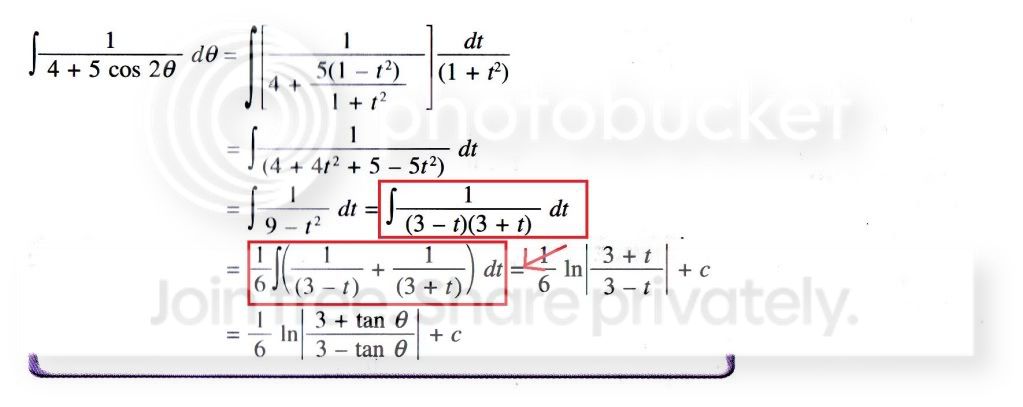
如何转换?
 |
|
|
|
|
|
|
|
|
|
|
|
发表于 13-3-2011 12:54 PM
|
显示全部楼层
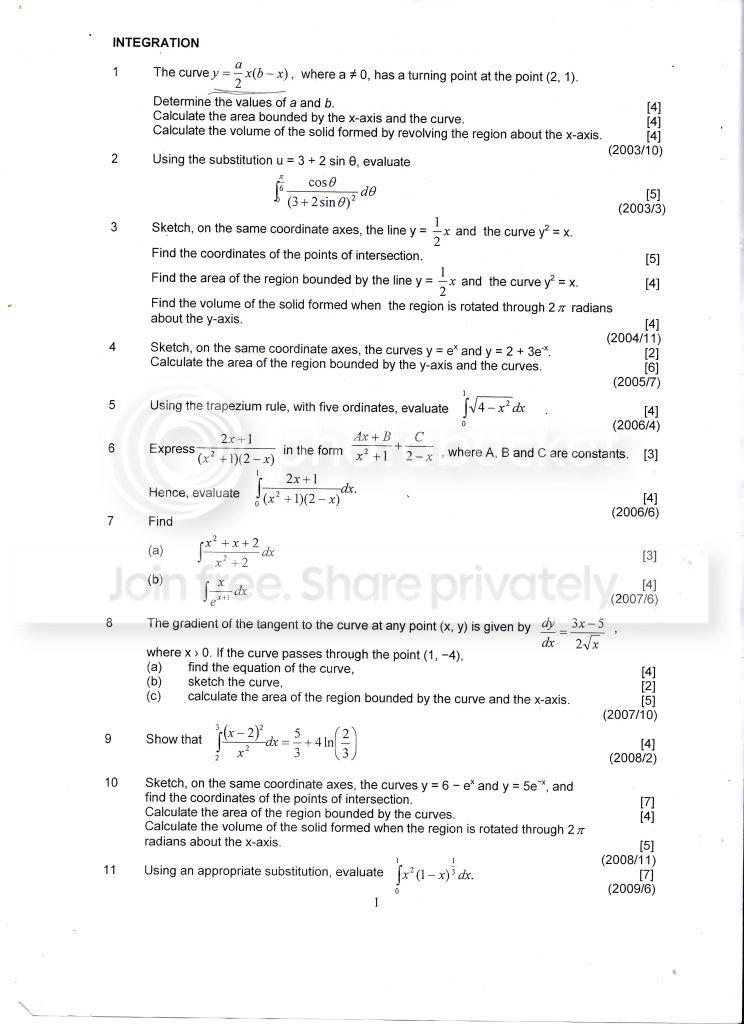
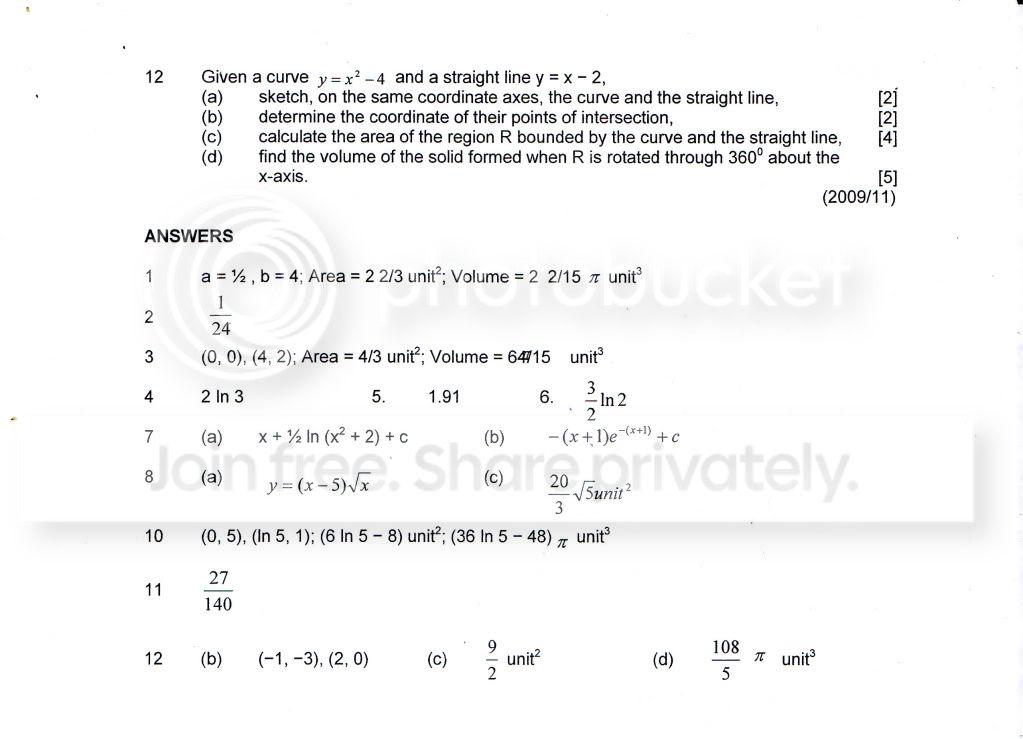
还有第二题。
 |
|
|
|
|
|
|
|
|
|
|
|
发表于 13-3-2011 04:03 PM
|
显示全部楼层
回复 2531# ultikiller
partial fraction 啊
let 1/(3+t)(3-t) = a/(3+t) + b/(3-t)
= [a(3-t) + b(3+t)] / (3+t)(3-t)
by comparison
[a(3-t) + b(3+t)] = 1
when t = 3 , 6b = 1
b= 1/6
when t=-3 , 6a =1
a= 1/6
therefore,
let 1/(3+t)(3-t) = 1/6(3+t) + 1/6(3-t)
=(1/6)[1/(3+t) + 1/(3-t)] |
|
|
|
|
|
|
|
|
|
|
|
发表于 13-3-2011 04:14 PM
|
显示全部楼层
回复 2532# ultikiller
let u = 3 + 2 sin x
x=0 , u=3
x= pi/6 , u=4
du/dx = 2 cos x
dx = du/2cos x
int cos x / (3+2sin x)^2 dx =int cos x / 2u^2 (du/2cos x) _u from 3 to 4
= int 1/2u^2 du _ u from 3 to 4
= [- 1/2u]_u from 3 to 4
= -1/2(4) - -1/2(3)
= -1/8 + 1/6
= 1/24 |
|
|
|
|
|
|
|
|
|
|
|
发表于 19-3-2011 08:28 AM
|
显示全部楼层
|
Each of the surfaces of a cube is expanding at the rate of 10cm^2 per second. find the rate of change of the volume of the cube when the surface area is 150cm^2. |
|
|
|
|
|
|
|
|
|
|
|
发表于 19-3-2011 01:36 PM
|
显示全部楼层
本帖最后由 whyyie 于 19-3-2011 01:53 PM 编辑
回复 2535# blazex
Let x be the side length of the cube
surface area of one side of the cube, A = x^2
dA/dt = (dA/dx) x (dx/dt)
A=x^2
dA / dx = 2x
dA/dt = 2x (dx/dt)
10 = 2x (dx/dt)
dx/dt = (5/x) cm/s
Let V be the volume of the cube
V = x^3
dV/dt = 3x^2 (dx/dt) = (3x^2) (5/x) = 15x
Total surface area = 6x^2
150 = 6x^2
x = 5 cm
At x = 5,
dV/dt = 15(5) = 75 cm^3 / s |
|
|
|
|
|
|
|
|
|
|
|
发表于 20-3-2011 01:03 PM
|
显示全部楼层
1)A right circular cone has base radius,r and height,h. As r and h vary, its curved
area is kept constant. Show that its volume is a maximum when r=rh(2^1/2).
2)A curve has parametric equation x=2t,y=1/t^2,where t is a real non-zero
parameter.
Find the equations of the tangent and the normal to the curve at the point
P(2t,1/t^2). The tangent at point Q(-2,1) meets the y-axis at T.The normal at
P meet the y-axis at N. Show that the area of triangle QTN is 4 units^2. |
|
|
|
|
|
|
|
|
|
|
|
发表于 23-3-2011 08:44 PM
|
显示全部楼层
本帖最后由 peaceboy 于 23-3-2011 09:01 PM 编辑
回复 2537# blazex
很可怜,米有人要solve
我很懒惰
1)A right circular cone has base radius,r and height,h. As r and h vary, its curved
area is kept constant. Show that its volume is a maximum when r=rh(2^1/2).
its curved area is kept constant , A= pi r S
s=(r^2 + h^2)^(1/2)
A= pi r (r^2 + h^2)^(1/2)
r^2 + h^2 = [A/ (pi r)]^2
h^2 = [A^2 - (pi)^2 r^4] / (pi r)^2
h=[A^2 - (pi)^2 r^4]^(1/2) / (pi r)
pi r h = [A^2 - (pi)^2 r^4]^(1/2) ---@
V= (1/3) pi r^2 h
=(1/3) (r) [A^2 - (pi)^2 r^4]^(1/2)
dv/dr= (r/3) [1/[A^2 - (pi)^2 r^4]^(1/2)] (-4 (pi)^2 r^3) + (1/3) [A^2 - (pi)^2 r^4]^(1/2)
sub @
dv/dr = (r/3)(1/2) [1/pi r h] (-4pi^2 r^3) + (1/3) pi r h
= (pi r h) /3 - 2 (pi)^2 r^3 / (3 pi h)
= (pi^2 r h^2 - 2 (pi)^2 r^3) / 3pi h
dv/dr =0
(pi^2 r h^2 - 2 (pi)^2 r^3) / 3pi h=0
pi^2 r h^2 - 2 (pi)^2 r^3=0
rpi^2[h^2 -2 r^2]=0
r pi^2 =0 , h^2 -2r^2=0
h^2 -2r^2=0
2r^2= h^2
r= h / (2)^(1/2)
第二等我的空才作 |
|
|
|
|
|
|
|
|
|
|
|
发表于 29-3-2011 09:18 PM
|
显示全部楼层
y=[4/square root(x)] use by first principle ,solve
let f(x) =4/square root(x) 8=delta
f(x+8x)=4/[square root(x+8x)]
f'(x)=lim {4/[square root (x+8x) - 4/[square root(x)] } / 8x
8-0
=lim (4/[square root(x)] - 4/[square root(x)] ) (1/8x)
8-0
=lim {4(squareroot (x) - 4(square root(x+8x) } / (squareroot (x+8x)(squareroots(x)(8x)
then?
TT please can teach me ,tq
8-0 |
|
|
|
|
|
|
|
|
|
|
|
发表于 30-3-2011 07:29 PM
|
显示全部楼层
y=[4/square root(x)] use by first principle ,solve
let f(x) =4/square root(x) ...
hongji 发表于 29-3-2011 09:18 PM
 |
|
|
|
|
|
|
|
|
|
| |
 本周最热论坛帖子 本周最热论坛帖子
|










 2166
2166  48
48


