|
|
The population of Aedes mosquitoes which carry the Dengue virus can be modeled by a differential equation which describes the rate of growth of the population. The population growth rate
dP/dt is given bydP/dt=rP(1-P/k), where r is positive constant and k is the carrying capacity.
1) When the population is small, the relative growth rate is almost constant. What do you understand by the term relative growth rate?
2) (a) Show that if the population does not exceed its carrying capacity, then the population is increasing.
b) Show that if the population exceeds its carrying capacity, then the population is decreasing.
3) (a) suppose that the initial population is P₀. Discuss, by considering the sign ofdP/dt, the relationship between P and k if P₀ is less than k and if P₀ is greater than k.
(b) Determine the values of P for constant growth, increasing growth and declining growth.
4) Determine the maximum value of dP/dtand interpret the meaning of this maximum value.
5) Express P in terms of r, k and t. Using different initial population sizes P₀, r and k, plot, on the same axes, a few graphs to show the behavior of P versus t.
6) The population sizes of the mosquitoes in a certain area at different times, in days, are given in the table below.
Time (days) Number of mosquitoes
0 40
35 77
63 125
91 196
105 240
126 316
140 371
182 534
203 603
224 658
245 701
252 712
322 776
371 791
392 794
406 796
441 798
504 799
539 800
567 800
It is interesting to determine the carrying capacity and the growth rate based on the above data to control the population of Aedes mosquitoes. Using different values of P and t, plot ΔP/Δtagainst P and hence obtain the approximate values for r and k. 这是题目,我们学校拿到了,不过问题都一样,就是毫无头绪。希望你们可以帮忙, 
|
|
|
|
|
|
|
|
|
|
|
|
 发表于 7-2-2013 08:59 PM
|
显示全部楼层
发表于 7-2-2013 08:59 PM
|
显示全部楼层
|
rP(1-P/k) or rP((1-P)/k)??? |
|
|
|
|
|
|
|
|
|
|
|
发表于 7-2-2013 10:10 PM
|
显示全部楼层
应该是 dP/dt = rP ( 1 - (P/k) ) 吧?
我觉得。 |
|
|
|
|
|
|
|
|
|
|
|
发表于 7-2-2013 10:21 PM
|
显示全部楼层
GHYENG 发表于 7-2-2013 10:10 PM 
应该是 dP/dt = rP ( 1 - (P/k) ) 吧?
我觉得。
你了解怎样解答吗???
|
|
|
|
|
|
|
|
|
|
|
|
发表于 7-2-2013 10:41 PM
|
显示全部楼层
第一题应该是definition? 不清楚。
第二题就是 let P<k 和 P>k
(a)
P < k
P/k < 1
1 - P/k > 0
所以整个 > 0 就positive了,(b)就倒转。
第三题 (a) 理解失败,放弃。
(b) 就是找values of P when dP/dt = 0, -ve or +ve。
第四题 max value,照课本做法吧,interpret我就不懂了。
第五题画几个graphs的不懂怎样说,应该就是画 f(x) , 1/f(x) 那几个吧?
第六题 graph work,找r k。 |
|
|
|
|
|
|
|
|
|
|
|
发表于 7-2-2013 11:06 PM
|
显示全部楼层
Relative growth rate is the growth rate relative to the size of the population. It is also called the exponential growth rate, or the continuous growth rate. In terms of differential equations, if P is the population, and dP/dt its growth rate, then its relative growth rate is 1⁄ dP⁄dt. If the relative growth rate is constant, i.e., 1⁄dP⁄dt=k, it is not difficult to verify that the solution to this equation is P(t) = exp(kt). When calculating or discussing relative growth rate, it is important to pay attention to the units of time being considered.[1] dP⁄dt. If the relative growth rate is constant, i.e., 1⁄dP⁄dt=k, it is not difficult to verify that the solution to this equation is P(t) = exp(kt). When calculating or discussing relative growth rate, it is important to pay attention to the units of time being considered.[1]
For example, if an initial population of P_0 bacteria doubles every twenty minutes, then at time t it is given by the equation P(t) = P_0*2^t = P_0*exp(ln(2)t) where t is the number of twenty-minute intervals that have passed. However, we usually prefer to measure time in hours or minutes, and it is not difficult to change the units of time. For example, since 1 hour is 3, twenty-minute intervals, the population in one hour is P(3)=P_0*2^3. The hourly growth factor is 8, which means that for every 1 at the beginning of the hour, there are 8 by the end. Indeed P(T) = P_0*8^T = P_0*exp(ln(8)T) where T is measured in hours, and the relative growth rate may be expressed as ln(2) or approximately 69% per twenty minutes, and as ln(8) or approximately 208% per hour.[1]
In plant physiology, Relative Growth Rate(RGR) is also a measure used to quantify the speed of plant growth. It is measured as the mass increase per aboveground biomass per day, for example as g g-1 d-1. It is considered to be the most widely used way of estimating plant growth, but has been criticised as calculations typically involve the destructive harvest of plants.[2] |
|
|
|
|
|
|
|
|
|
|
|

楼主 |
发表于 8-2-2013 10:01 PM
|
显示全部楼层
|
guys, the question there really mentioned that dP/dt = rP(1 - P/K). |
|
|
|
|
|
|
|
|
|
|
|
发表于 8-2-2013 10:24 PM
|
显示全部楼层
ChenHongDe 发表于 8-2-2013 10:01 PM
guys, the question there really mentioned that dP/dt = rP(1 - P/K).
是的,和老师查证过了(老师有teacher's manual),的确是 dP/dt = rP(1 - (P/k)),这是logistic growth rate。
还有请用中文发言哦。
|
|
|
|
|
|
|
|
|
|
|
|
发表于 8-2-2013 10:31 PM
|
显示全部楼层
In ecology: modeling population growth
Pierre-François Verhulst (1804–1849)
A typical application of the logistic equation is a common model of population growth, originally due to Pierre-François Verhulst in 1838, where the rate of reproduction is proportional to both the existing population and the amount of available resources, all else being equal. The Verhulst equation was published after Verhulst had read Thomas Malthus' An Essay on the Principle of Population. Verhulst derived his logistic equation to describe the self-limiting growth of a biological population. The equation is also sometimes called the Verhulst-Pearl equation following its rediscovery in 1920. Alfred J. Lotka derived the equation again in 1925, calling it the law of population growth.
Letting P represent population size (N is often used in ecology instead) and t represent time, this model is formalized by the differential equation:
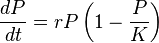
where the constant r defines the growth rate and K is the carrying capacity.
In the equation, the early, unimpeded growth rate is modeled by the first term +rP. The value of the rate r represents the proportional increase of the population P in one unit of time. Later, as the population grows, the second term, which multiplied out is −rP2/K, becomes larger than the first as some members of the population P interfere with each other by competing for some critical resource, such as food or living space. This antagonistic effect is called the bottleneck, and is modeled by the value of the parameter K. The competition diminishes the combined growth rate, until the value of P ceases to grow (this is called maturity of the population).
Dividing both sides of the equation by K gives

Now setting  gives the differential equation gives the differential equation
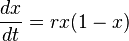
For  we have the particular case with which we started. we have the particular case with which we started.
In ecology, species are sometimes referred to as r-strategist or K-strategist depending upon the selective processes that have shaped their life history strategies. The solution to the equation (with  being the initial population) is being the initial population) is 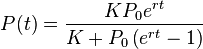 where  Which is to say that K is the limiting value of P: the highest value that the population can reach given infinite time (or come close to reaching in finite time). It is important to stress that the carrying capacity is asymptotically reached independently of the initial value P(0) > 0, also in case that P(0) > K.
|
评分
-
查看全部评分
|
|
|
|
|
|
|
|
|
|
|
发表于 22-2-2013 11:03 PM
|
显示全部楼层
GHYENG 发表于 8-2-2013 10:31 PM
In ecology: modeling population growth
Pierre-François Verhulst (1804–1849)
A typical applic ...
请问这儿哪找的?可以PM给我网址吗?
|
|
|
|
|
|
|
|
|
|
| |
 本周最热论坛帖子 本周最热论坛帖子
|










 变色卡
变色卡 千斤顶
千斤顶


 884
884  109
109


